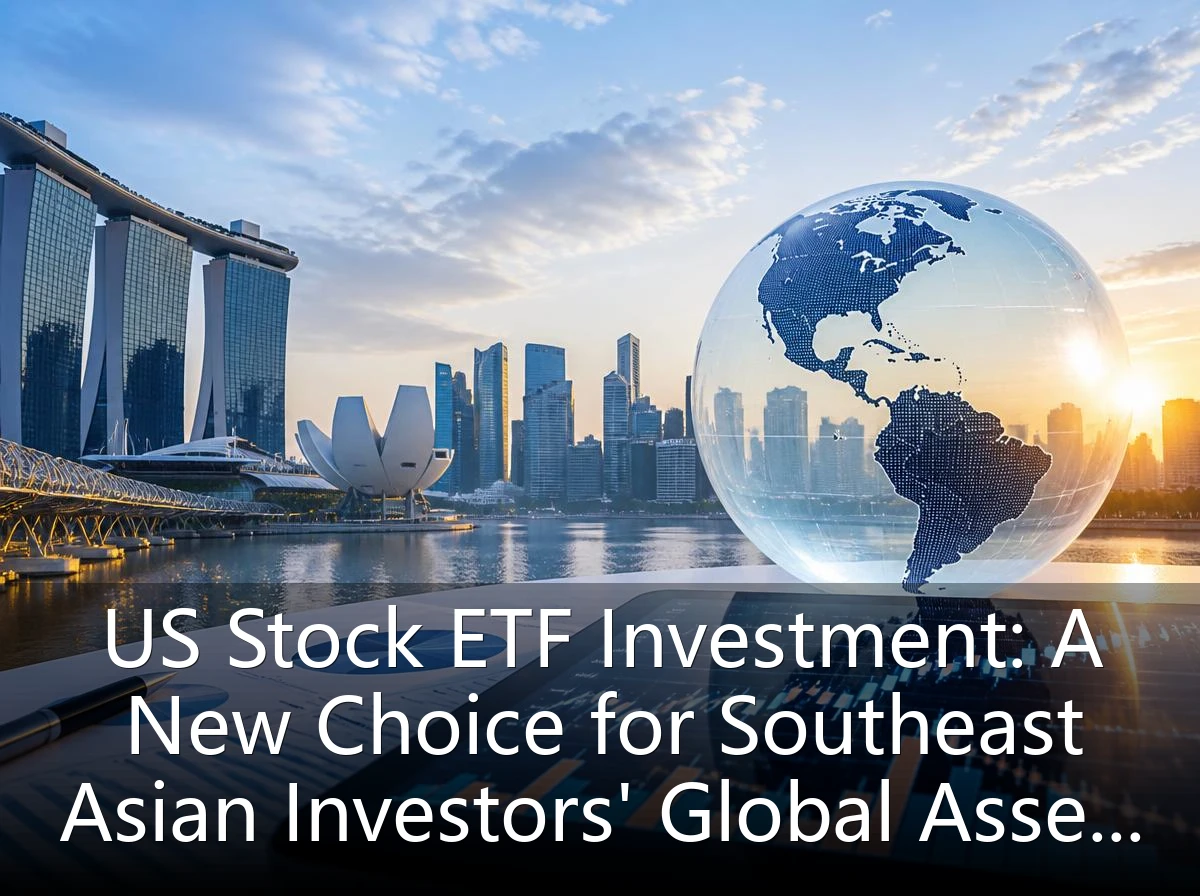

US Stock ETF Investment: A New Choice for Southeast Asian Investors' Global Asset Allocation in 2026
In August 2026, as the global financial market undergoes profound changes, Southeast Asian investors seeking to preserve and increase the value of their assets have found US stock ETFs (Exchange Traded Funds) to be important tools for achieving global asset allocation. With the continued recovery of the US economy, outstanding performance of tech giants, and shifts in Federal Reserve policy, the US stock market has demonstrated unique investment value. This article will provide an in-depth analysis of the advantages, investment strategies, and risk control of US stock ETFs, offering new perspectives on US stock investment for Southeast Asian investors.
I. US Stock ETFs: The Ideal Choice for Southeast Asian Investors
As an investment tool that combines the features of open-ended funds and stocks, ETFs have rapidly gained popularity worldwide in recent years. For Southeast Asian investors, US stock ETFs offer multiple advantages:
- Low Cost, High Efficiency: Compared to directly purchasing individual US stocks, ETFs typically have lower management fees and transaction costs, and can avoid the risks of individual stock selection.
- High Transparency: ETF holdings are publicly disclosed, allowing investors to clearly understand where their funds are invested.
- Excellent Liquidity: ETFs are listed and traded on stock exchanges, allowing buying and selling at any time like stocks, solving the inconvenience of subscription and redemption of open-ended funds.
- Risk Diversification: Through a basket of securities, effectively diversifying risks of individual stocks or industries.
- Low Investment Threshold: Small amounts of capital can invest in multiple US industries and indices, achieving global asset allocation.
Although Southeast Asian financial markets are developing rapidly, their depth and breadth remain limited. Through US stock ETFs, investors can easily access the world's best enterprises and industries, achieving global asset allocation.
II. Core Attractions of the US Stock Market in 2026
In 2026, despite uncertainties in global economic growth, the US stock market continues to demonstrate strong resilience and attractiveness:
1. Gathering of the World's Best Enterprises
The US stock market brings together the world's most innovative and competitive enterprises, especially in technology, healthcare, and consumer sectors. Tech giants like Apple, Microsoft, and Google continue to drive the development of cutting-edge technologies such as artificial intelligence and cloud computing; healthcare companies like Johnson & Johnson and Pfizer maintain leading positions in the biopharmaceutical field; and consumer goods giants like Coca-Cola and Procter & Gamble possess strong brand value and global market share.
Through US stock ETFs, Southeast Asian investors can share in the growth dividends of these global leading enterprises at a lower threshold without bearing the risks of individual stock selection.
2. High Market Transparency, Perfect Regulation
The US securities market has the world's most complete regulatory system and information disclosure system. Listed companies' financial data is disclosed in a timely and accurate manner, and investor protection mechanisms are sound. This highly transparent market environment reduces investment risks caused by information asymmetry, providing a solid foundation for long-term value investment.
3. Significant Liquidity Advantages
The US stock market is one of the most liquid markets in the world, with daily trading volumes reaching hundreds of billions of dollars. This high liquidity means investors can buy or sell ETF shares at any time at reasonable prices, reducing transaction costs and market impact costs.
4. Stable Long-term Returns
Historical data shows that the long-term return rate of the US stock market significantly outperforms other major asset classes. Even after experiencing the impact of the 2020 pandemic and the inflationary pressures of 2022, the S&P 500 index has still achieved an average annual return of approximately 10% over the past decade. For Southeast Asian investors, US stock ETFs provide an effective way to participate in global economic growth and obtain long-term stable returns.
III. Types of US Stock ETFs Suitable for Southeast Asian Investors
According to different investment objectives and risk preferences, Southeast Asian investors can choose different types of ETFs:
1. Index ETFs
Index ETFs track specific market indices, such as S&P 500 ETF (SPY), Nasdaq 100 ETF (QQQ), and Dow Jones Industrial Average ETF (DIA). These ETFs provide broad market exposure, suitable for investors who are optimistic about the overall performance of the US economy.
2. Sector ETFs
Sector ETFs focus on specific industries, such as Technology XLK, Financial XLF, Healthcare XLV, etc. In 2026, ETFs in technology, healthcare, and clean energy sectors have shown particularly outstanding performance, attracting significant attention from Southeast Asian investors.
3. Thematic ETFs
Thematic ETFs focus on specific investment themes, such as artificial intelligence, robotics, electric vehicles, and other cutting-edge fields. For Southeast Asian investors who are optimistic about future technology development trends, these ETFs provide opportunities to participate in the technological revolution.
4. Bond ETFs
Bond ETFs such as US Treasury ETF (TLT) and high-yield corporate bond ETF (HYG) provide stable income sources and lower risk levels, suitable for Southeast Asian investors with lower risk preferences.
IV. US Stock ETF Investment Strategies for 2026
Facing a complex market environment, Southeast Asian investors can adopt the following strategies to optimize ETF investment:
1. Diversified Asset Allocation
According to modern portfolio theory, reasonable asset allocation is the key to investment success. Southeast Asian investors can allocate funds to different types of ETFs, such as stock ETFs, bond ETFs, commodity ETFs, etc., to achieve risk diversification and stable returns.
2. Dollar-Cost Averaging Strategy
Regularly investing fixed amounts in ETFs can reduce the impact of market fluctuations on investments and improve investment efficiency through the average cost method. For long-term investors, dollar-cost averaging is a simple and effective investment method.
3. Volatility Management
In 2026, as global market volatility intensifies, Southeast Asian investors can reduce market risk by allocating to low-volatility ETFs (such as low-volatility index ETFs) or using derivatives like options for hedging.
4. Lifecycle Investment
According to the investor's age, risk tolerance, and investment horizon, dynamically adjust the ETF portfolio. Young investors can increase allocations to growth-oriented ETFs, while investors approaching retirement should increase the proportion of bond ETFs and dividend ETFs.
V. Risk Management and Considerations
Although ETFs have many advantages, Southeast Asian investors should pay attention to the following risks when investing in US stock ETFs:
1. Exchange Rate Risk
Due to being denominated in US dollars, US stock ETF investments face exchange rate fluctuation risks. Southeast Asian investors can hedge exchange rate risks through currency-hedged ETFs or using tools like forward contracts.
2. Market Risk
The US stock market is highly interconnected with global markets. Geopolitical factors, economic policies, and other factors can all trigger market fluctuations. Investors should closely monitor US economic data, Federal Reserve policy changes, and international developments.
3. Liquidity Risk
Although most mainstream ETFs have good liquidity, during market volatility, some niche ETFs may experience liquidity problems. Investors should prioritize ETF products with good liquidity and large scale.
4. Tax Considerations
Different countries have different tax policies for overseas investments. Southeast Asian investors should understand their country's tax regulations, plan their investment structure reasonably, and maximize after-tax returns.
VI. Future Outlook: Development Trends of US Stock ETFs
Looking ahead, the US stock ETF market will continue to show the following development trends:
1. Accelerated Product Innovation
With the diversification of investor demand, ETF products will become more segmented and innovative, covering more industries, themes, and investment strategies. ETFs in cutting-edge fields such as artificial intelligence and blockchain are expected to become new growth points.
2. Popularization of ESG Investment
The concept of Environmental, Social, and Governance (ESG) investment is becoming increasingly popular. ESG-themed ETFs will attract more attention from Southeast Asian investors who focus on sustainable development.
3. Rise of Actively Managed ETFs
Actively managed ETFs combine active investment strategies with the trading convenience of ETFs, and are expected to open up new investment space beyond traditional passive ETFs.
4. Interconnection of Southeast Asian Markets
As the openness of Southeast Asian financial markets increases, interconnection with the US stock market will become more convenient, reducing the threshold and costs for Southeast Asian investors to invest in US stock ETFs.
VII. Conclusion
In 2026, against the backdrop of profound adjustments in the global economic landscape, US stock ETFs provide Southeast Asian investors with a convenient, efficient, and low-cost tool for global asset allocation. By reasonably selecting different types of ETFs, formulating scientific investment strategies, and implementing proper risk management, Southeast Asian investors can fully share in the fruits of US economic growth and technological innovation, achieving asset preservation and appreciation.
With the growth of wealth in the Southeast Asian region and increasing financial openness, more and more investors are turning their attention to global markets. With their unique advantages, US stock ETFs will become an important choice for Southeast Asian investors to achieve global asset allocation. In the future, with product innovation and regulatory improvements, US stock ETFs are expected to play an even more important role in the investment portfolios of Southeast Asian investors.
For Southeast Asian investors committed to global asset allocation, understanding the characteristics of US stock ETFs, mastering investment strategies, and grasping market trends will be key to standing firm in the wave of global investment. With risks under control, US stock ETFs may be the key that opens the door to global wealth.