

El Niño Strikes: Your Breakfast and Wallet May Be "Heated" Up
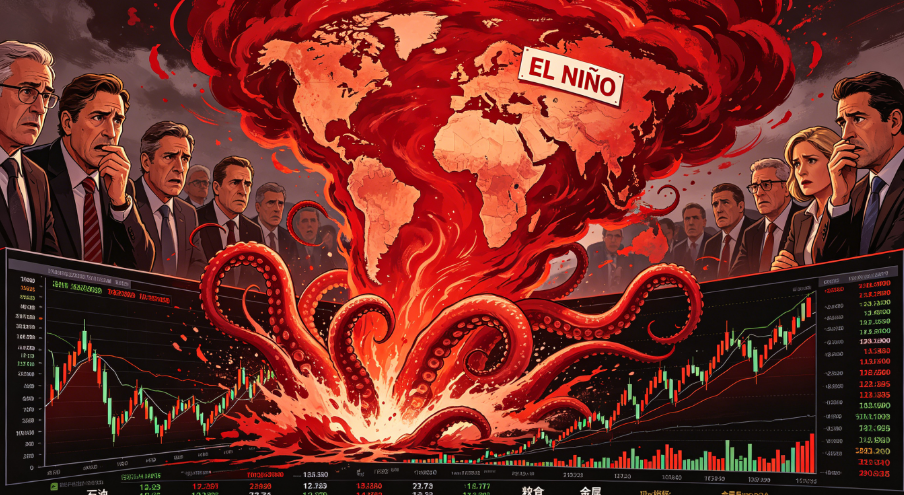
Recently, have you noticed the weather getting more extreme? Either torrential rains or drought. Don't blame the weather just yet, because the real heavyweight—El Niño—may have already started quietly causing trouble. The National Oceanic and Atmospheric Administration (NOAA) recently warned: the probability of an El Niño event this year exceeds 90%, and there is a one-in-four chance it could become a super event like 1997-1998. If you don't remember that disaster, simply put: crop yields drop, food prices soar, and global inflation gets pushed higher.
What's more troubling is that people initially thought the easing of US-Iran tensions and the reopening of the Strait of Hormuz would lower energy costs and let inflation take a breather—but now it turns out that before that breath is fully taken, climate shocks have taken over. Experts warn that global food commodity prices could surge by 9% this year! Your coffee, chocolate, bread, and even cotton T-shirts are all on the price rise list.
El Niño Is Coming to Cause Trouble, Grain Prices Can't Hold First
"Weather Clock" senior meteorologist Joe Bastardi has already signaled that pressure changes in the central and western Pacific indicate El Niño has actually started. What does "actually started" mean? It's not like a typhoon that is "expected to come next month," but like a frog in slowly boiling water—by the time you realize something is wrong, you're already half-cooked.
UK commodity broker Marex issued a special report, pointing out that this El Niño will severely disrupt the production cycles of tropical and temperate crops. The most affected are wheat, rice, cotton, sugar, cocoa, and palm oil. The bread you eat daily, the milk tea you drink, the jeans you wear, and the cosmetics you use are almost all within the strike range. Historical data also proves that the 1997 El Niño caused massive production cuts in traditional granaries like Australia, Russia, and Ukraine, sending global grain prices skyrocketing.
What's worse, farmers are not fools—they see such extreme climate and fear a total loss, so they may actively reduce planting areas. This "pro-cyclical behavior" is like adding fuel to the fire: if production might already drop, and you stop planting, prices will surely go through the roof.
Inflation Storm Not Over Yet, Energy Prices Also Adding Trouble
T. Rowe Price fund manager Chris Faulkner-MacDonald stated a blunt fact: this El Niño comes at a very bad time. Global crops were already fragile—traditional US agricultural regions are suffering severe drought, and last summer's heatwave in Europe is still fresh in memory. Initially, everyone hoped that after the US-Iran conflict ended and the Strait of Hormuz reopened, energy costs would drop and bring inflation down. But MacDonald hit the nail on the head: this ignores the stubbornness of structural inflation.
What is structural inflation? It's not caused by a single event but deeply rooted and intertwined price increase drivers. Besides disrupted agricultural supply chains, global manufacturing capacity adjustments are also pushing up costs, along with massive demand from data center construction for high-energy-consumption and high-tech components—all blocking the path for inflation to fall on the supply side. Jefferies' forward energy contract data also shows that international crude oil futures are expected to remain $10 to $15 per barrel higher than before the US-Iran conflict for the next two years. If oil prices don't come down, nothing will.
Major Players Are Quietly Repositioning: Four Directions Worth Watching
Facing the prospect of "inflation remaining high for a long time," Wall Street investment institutions are not sitting idle. They have started adjusting asset allocation, and international capital flows show clear hedging trends. Although ordinary people may not directly trade commodities, understanding the thinking of these big players may provide some inspiration for our own wallets.
Direction 1: Hedging Commodity Funds in Demand
These funds act like a "jack-of-all-trades"—they dynamically rebalance quarterly and diversify investments across various commodities. Recently, capital inflows have accelerated significantly, and some flagship products' three-year annualized returns have outperformed the Bloomberg Commodity Total Return Index. Simply put, by using a basket of commodities to hedge against the risk of a single variety, they seek steady progress.
Direction 2: Agricultural Supply Chain Leaders Being Accumulated
Think about it: the more expensive grain becomes, the more profitable farming is, but only if you have output. The world's largest fertilizer producer, Nutrien (Canada), and agricultural machinery giant Deere & Company, which help farmers increase per-acre yield and reduce labor costs, have become key buys for safe-haven funds. Whatever is planted, fertilizer and machinery are always needed.
Direction 3: Gold and Royalty Assets—Veteran Inflation Hedges
First Eagle Investment Management likes to play high-level games like "gold royalties." Royalty companies act like "landlords"—they provide capital to miners in exchange for a share of future output. This way, they can both hedge against inflation and avoid the increasingly high operational cost risks of the mining industry. In other words, they sit back and share profits, with much less risk than direct mining.
Direction 4: Core Real Estate—Traditional Inflation Hedge
Although the interest rate environment is uncertain now, comprehensive commercial real estate investment trusts (REITs) on the US West Coast and in major economically active states have recently seen frequent large insider purchases. These insiders know best the true underlying value—physical real estate has a centuries-old traditional advantage in combating purchasing power erosion. Think about it: no matter how much office buildings and shopping malls in big US cities depreciate, rents keep rising, and the higher the inflation, the more rents rise.
Conclusion: Better to Prepare in Advance Than to Worry
Back to ourselves—we may not be able to allocate assets on the scale of Wall Street, but understanding this logic can help us make many decisions. For example, pay attention to changes in daily food prices and moderately stock up on non-perishable grains (but not too much); if your job is related to agriculture, energy, or logistics, you may need to pay more attention to climate risks this year; if your investment portfolio includes inflation-linked instruments, you can hold them appropriately.
El Niño is coming, not the end of the world, but a test. A test of supply chain resilience, a test of central banks' decision-making wisdom, and a test of ordinary people's ability to cope. Remember, every crisis hides opportunities—the key is whether you see it coming in advance.