

Dow Component Change: Alphabet Joins and Market Structure Evolution
Introduction
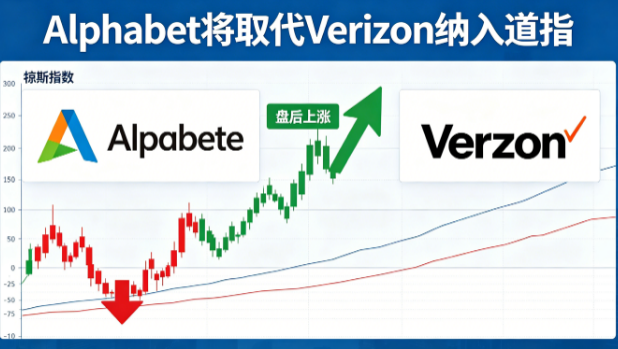
In June 2024, the Dow Jones Industrial Average saw a notable component adjustment: Google parent company Alphabet replaced telecom giant Verizon Communications as a new member of this century-old blue-chip index. Meanwhile, Honeywell International confirmed its retention, but its plan to spin off its aerospace business did not earn a Dow seat. This change may seem simple, but it reflects the deep macro trend of the US economy shifting from traditional industry and communications to technology and digital services. For index investors, quantitative analysts, and macro strategy researchers, the technical logic and market implications behind this adjustment are worth in-depth analysis.
Deep Logic of the Dow Adjustment: Price Weighting and Industry Representation
As one of the oldest stock indices, the Dow Jones Industrial Average uses a price-weighted rather than market-cap-weighted mechanism. This means stocks with higher prices have a greater impact on the index's movement. Alphabet's current stock price of around $346 is far higher than Verizon's approximately $40. Under price weighting, Alphabet's inclusion will significantly boost the tech sector's weight in the Dow, while the telecom sector's representation weakens further. This adjustment is not accidental—the Dow committee has always aimed to maintain the index's forward-looking reflection of economic structure. Verizon's telecom services industry has seen weak growth in recent years, with prolonged 5G investment return cycles, and its industry position has been surpassed by technology services like cloud computing and AI.
Impact of Alphabet's Inclusion on the Index: Weight Restructuring and Volatility Changes
From a technical indicator perspective, Alphabet's inclusion will change the Dow's industry distribution. Before the adjustment, the information technology sector's weight in the Dow was around 20%; after adding Alphabet, it may rise to over 25%. Given Alphabet's stock volatility (annualized about 35%) is higher than Verizon's (about 20%), the index's overall volatility is expected to increase slightly. For passive investors seeking lower tracking error relative to the S&P 500 (market-cap weighted), the correlation between the Dow and the S&P 500 may further strengthen—because Alphabet is one of the highest-weighted stocks in the S&P 500 (about 4%), but the Dow's price weighting mechanism will compress its influence. Investors need to reassess derivative pricing models based on the Dow, especially Delta and Gamma exposures in option strategies.
Verizon's Exit and the Decline of the Telecom Sector: End of an Era
Verizon joined the Dow in 2000 and was a representative of traditional blue chips after the "new economy" bubble. However, the telecom industry is facing structural challenges: wireless user penetration has peaked, capital expenditures remain high, and the competitive landscape has evolved from three giants to cross-competition with tech giants. Verizon's stock has fallen about 25% over the past five years, while Alphabet has risen over 150% over the same period. More importantly, the telecom industry's moat is being eroded by technologies such as cloud computing, satellite Internet, and fixed wireless access. The Dow committee's decision essentially acknowledges that the telecom industry no longer has the long-term growth resilience and economic leadership required by the "Industrial Average."
Symbolic Meaning of Honeywell and Aerospace Spin-off
Notably, while Honeywell International confirmed it will remain in the Dow, its aerospace business spin-off plan did not qualify for inclusion. This reflects the Dow committee's insistence on index "purity": aerospace belongs to the industrial sector, but the standalone entity may not yet meet blue-chip standards in market cap and liquidity. Technically, Honeywell's retention also ensures that industrial automation and aerospace maintain appropriate weight in the Dow, preventing the index from being overly tilted toward pure tech stocks.
Technical Implications for Investors and Markets
- Index Rebalancing Strategies: Active managed funds should consider rebalancing positions before the adjustment takes effect (before the open on June 29), reducing Verizon exposure and increasing Alphabet positions. Given that Verizon's stock fell 0.5% after the announcement and Alphabet rose 1.2% after hours, there is short-term arbitrage opportunity, but liquidity risk should be noted.
- Implied Volatility Arbitrage: Alphabet's option implied volatility may show term structure distortions due to index weight changes; experienced investors can consider calendar spreads or butterfly spreads.
- Sector Rotation Signals: This adjustment reinforces the "tech perpetual growth" market narrative, but cautious investors should also watch for valuation premium bubbles from index adjustments—Alphabet's P/E ratio of about 28 times is far higher than Verizon's 8 times, but growth expectations are partially priced in.
Conclusion
Alphabet replacing Verizon as a Dow component is not just a name change but a landmark event in the US economy's shift from "connecting devices" to "understanding data." For technical analysts, this adjustment provides a classic case study for studying index composition rules, industry life cycles, and market pricing efficiency. The future Dow will be more vulnerable to the price volatility of big tech, but will also better represent the core engine of economic growth. Only by understanding the microstructural logic behind index-level changes can investors find stable anchors in volatile markets.